


Syllabus: GS3/Economy
In News
- Recently, the National Cooperative Policy completed one year of implementation.
Background
- The cooperative movement in India is based on the philosophy of “Vasudhaiva Kutumbakam” (the world is one family) which emphasises collective welfare, cooperation, and community-led development.
- With the guiding vision of ‘Sahkar Se Samriddhi’, the Government has strengthened the cooperative sector through supportive policies, institutions and grassroots outreach.
- The movement was legally recognised by the Cooperative Credit Societies Act, 1904, and it blossomed to become a major pillar of decentralised development after Independence.
- The creation of institutions like the National Cooperative Development Corporation (1963) and NABARD (1982) strengthened cooperative financing and rural development.
What is Cooperatives?
- It is an autonomous association of persons, united voluntarily to meet their common economic, social, and cultural needs and aspirations through a jointly owned and democratically member-controlled enterprise.
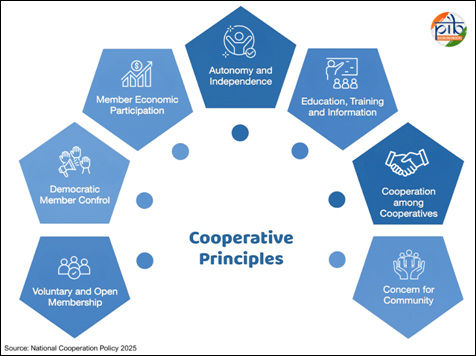
- Cooperatives in India are guided by core cooperative principles and they are owned by members, operated by members, and for the benefit of members.
Present Status
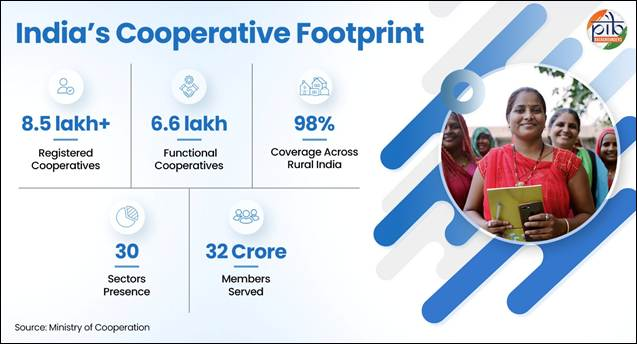
- Indian cooperatives today operate in agriculture, banking, credit, housing and women’s welfare and represent more than one-fourth of the world’s cooperatives.
Importance of Cooperatives
- Socio-economic upliftment: The Indian cooperative movement has been the flag bearer of a participatory, people-led development model aimed at socio-economic upliftment at the grassroots level for more than a century.
- Job Creation and Local Income: Co-operatives create jobs through their community-owned business model in which they employ people locally and share the work among members.
- Unlike large corporations, co-ops invest back into their communities, building skills and livelihoods.
- Fair Prices and Risk Sharing: By aggregating produce and bypassing middlemen, co-operatives help members get better prices.
- Amul and SOFA members earn higher-than-market rates. Co-operatives also distribute profits and reduce risk during crises, as seen during the COVID-19 lockdown when many supported members with interest-free loans.
- Women’s Empowerment and Social Inclusion: Co-operatives give ownership and decision-making roles to women and marginalised groups.
- Lijjat’s model, for example, allows women to earn at home while gaining full control over their enterprise.
- Infrastructure and Services in Villages: Thousands of Primary Agriculture Cooperative Credit Societies (PACS) now function as multi-service centres.
- Co-operative banks issue Kisan Credit RuPay cards, ATMs, and mobile banking to members, boosting rural financial inclusion.
- Self-Reliance and Localised Economies: Co-operatives build self-sufficiency. They stabilise prices, offer better bargaining power, and ensure that economic value stays within the community.
- This aligns the vision of Atmanirbhar Bharat, a version of self-reliant India grounded in village-level strength.
Challenges Faced by Co-operatives
- Over-regulation, political interference, democratic functioning, and lack of professional management affect the efficiency and autonomy of co-operatives.
- Long-term financial viability is hampered by poor financial management, lack of access to capital, reliance on government support, and weak internal oversight.
- Outdated laws, multiple regulatory regimes, complex registration processes and high compliance costs create hurdles for cooperatives.
- Small-scale operations, poor infrastructure, weak marketing and growing competition from private and global players are hampering the growth and competitiveness of cooperatives.
- Low adoption of digital technologies, modern production techniques and supply chain systems results in lower productivity, operational efficiency and market outreach.
Various Iniatives taken by the government
- Constitutional Provisions: The 97th Constitutional Amendment Act, 2011 provided the impetus to the cooperative movement by inserting Part IXB in the Constitution and recognising the right to form cooperative societies under Article 19(1)(c) as a Fundamental Right.
- It also inserted Article 43B into the Directive Principles of State Policy, directing the State to promote the voluntary, autonomous, democratic, and professional management of cooperative societies.
- Even though the Constitution makes cooperatives a State subject, multi-state cooperative societies (with members and operations spread across more than one state) are governed by the Multi-State Co-operative Societies (Amendment) Act, 2023.
- National Cooperation Policy (NCP) 2025: It was launched in July 2025 to replace the 2002 Policy, which had become obsolete in the face of rapid changes owing to globalisation, digitisation and socio-economic transformation.
- It marks a strategic roadmap for revitalizing India’s cooperative sector to meet the nation’s goal of becoming “Viksit” by 2047.
- It is rooted in the ethos of Sahkar-se-Samriddhi, and it aims to build on the unique strengths of India’s cooperative tradition, promote economic democratization, and uplift rural economies through collective participation.
- Computerization of Primary Agricultural Credit Societies (PACS): It is a Centrally Sponsored Scheme approved in 2022 to transform PACS into digitally enabled institutions by 31 March 2027
- Bharat Taxi: An initiative of Sahakar Taxi Cooperative Limited. Sahakar Taxi Cooperative Limited is a driver-centric mobility platform based on the cooperative model. It aims to economically empower drivers while offering affordable, safe, and reliable transport services to the public.
- Tax Relief & Ease of Doing Business:
- Policy reforms have also improved the financial health of cooperatives. Key tax relief measures introduced for cooperatives are:
- Surcharge reduced from 12% to 7% for cooperatives having income between ₹1-10 crore
- Minimum Alternative Tax (MAT) reduced from 18.5% to 15%
- TDS cash withdrawal limit raised from ₹1 crore to ₹3 crore
- Higher cash transaction limits for PACS & Primary Cooperative Agriculture and Rural Development Banks
- White Revolution 2.0: Aimed at expanding cooperative coverage, employment generation and women’s empowerment with the target of increasing the milk procurement of dairy cooperatives by 50% from the present level over the next five years.
- Multi-State Cooperative Societies (MSCS) (Amendment) Act & Rules, 2023: To strengthen governance, enhance transparency, increase accountability and reform electoral process in the Multi-State Cooperative Societies.
- Establishment of Ministry of Cooperation: It was created in July 2021 to oversee the work of cooperative societies and agriculture credit societies
Conclusion
- Cooperatives have the potential to play a transformative role in India’s socio-economic development.
- By addressing key challenges such as governance issues, financial sustainability, regulatory hurdles, and technological gaps, cooperatives can be better equipped to contribute to inclusive growth.
- With the right reforms, capacity-building initiatives, and support, cooperatives can foster economic empowerment, especially for marginalized and rural communities, and play a crucial role in achieving sustainable and equitable development in India.
Source : PIB
Previous article
Antarctic Cryosphere
Next article
Money Laundering
